

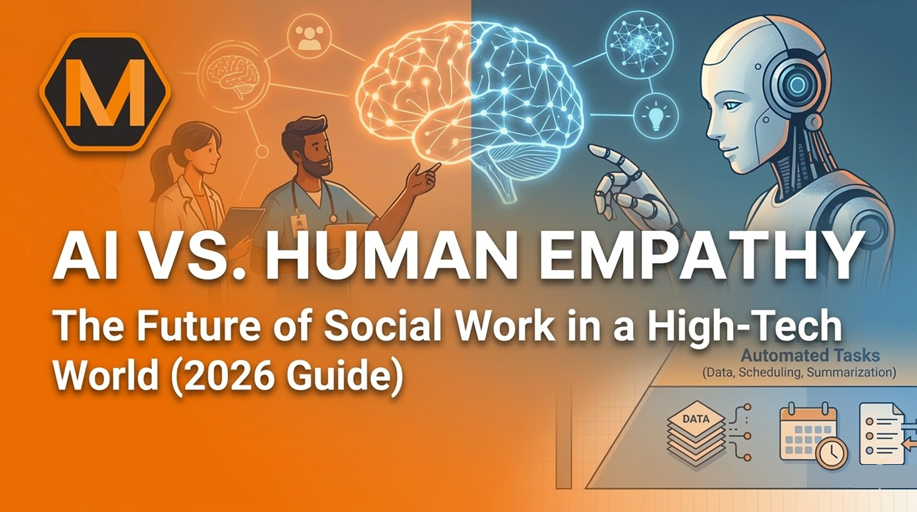
The landscape of social work is undergoing a quiet but profound transformation. For decades, the heart of this profession has been the “human element”—the ability to sit in a room with someone, sense their unspoken pain, and offer a level of understanding that only another person can provide. However, as we move further into 2026, the introduction of sophisticated Artificial Intelligence is challenging the status quo. From predictive algorithms that identify at-risk families to “empathic” chatbots designed to provide 24/7 mental health support, technology is no longer just a tool; it is becoming a participant in the social care ecosystem. This shift represents a move from traditional casework to “Social Work 2.0,” where data and pulse-checks happen in real-time.
This shift raises a critical question for the next generation of professionals: can a machine ever truly care? While a computer can process data at speeds no human can match, it lacks the lived experience and biological mirror neurons that drive genuine compassion. For students currently entering this field, the complexity of these socio-technical shifts is immense. Many find that balancing the technical requirements of modern policy with traditional ethics is a heavy lift, often leading them to seek out specialized coursework help from experts like myassignmenthelp to ensure they grasp these evolving concepts. Understanding the intersection of digital efficiency and human touch is now the baseline for any aspiring social scientist, as the curriculum now demands a blend of data science and psychology.
The Rise of “Affective Computing” in Social Care
The technology behind this change is known as “affective computing.” This isn’t your standard chatbot that gives canned responses; these are systems trained on millions of human facial expressions, voice tonalities, and linguistic patterns. In a social work context, these AI systems can act as an early-warning system. By analyzing patterns in a community’s digital health records or even subtle changes in a person’s social media activity, AI can predict which households might be heading toward a crisis before it actually happens. This “predictive risk modeling” offers a chance for preventive care, which is a massive leap forward from the reactive nature of traditional social work where help often arrives only after a tragedy.
However, the “AI vs. Human Empathy” debate isn’t just about efficiency; it’s about the quality of the connection. Human empathy is a “two-way street” involving vulnerability. When a caseworker shares a moment of silence with a grieving client, there is a biological and emotional exchange—a release of oxytocin and a synchronization of heart rates—that builds trust. An AI can mimic the words of comfort using Natural Language Processing (NLP), but it cannot share the weight of the emotion. For the high school senior or college freshman looking at this field, it’s important to realize that technology will likely handle the paperwork and the data sorting, while the human will be reserved for the high-intensity emotional “heavy lifting.”
Navigating the Ethics of Algorithmic Bias
One of the biggest hurdles in a high-tech social work world is the “Black Box” problem. Algorithms are only as fair as the data they are fed. If an AI is trained on historical data that contains human biases—such as prejudices against certain neighborhoods, specific ethnicities, or marginalized demographics—the AI will simply automate and scale those biases. In social work, where justice and equality are core values, this is a significant ethical risk. We run the risk of creating a “digital divide” where low-income individuals are managed by cold, rigid algorithms that deny services based on a score, while those with resources get the luxury of human attention and advocacy.
As students tackle these dense topics in their studies, the sheer volume of research required to stay current with global technological policy can be overwhelming. Whether it is analyzing case studies on digital ethics or writing papers on social stratification in the digital age, many turn to a social science Assignment Help service to help structure their arguments and find peer-reviewed sources that reflect the 2026 landscape.
A Comparative Analysis: Human vs. Artificial Empathy
To understand the future, we must look at what machines can do versus what humans must do. The table below breaks down the core competencies required in modern social work.
| Feature | Artificial Intelligence (AI) | Human Social Worker |
| Speed of Analysis | Instantaneous; can scan thousands of records. | Slower; requires manual review. |
| Empathy Type | “Cognitive/Artificial” (Simulated) | “Affective/Genuine” (Felt) |
| Bias Potential | High (encoded in data). | Medium (individual unconscious bias). |
| Availability | 24/7; zero fatigue. | Limited; high risk of burnout. |
| Decision Making | Based on probability and logic. | Based on nuance, ethics, and “gut feeling.” |
| Crisis Intervention | Good for basic de-escalation. | Essential for complex, life-threatening crises. |
The Hybrid Model: A New Socio-Technical Framework
The future isn’t a choice between humans or robots; it’s about a hybrid model. Imagine a caseworker who is freed from six hours of data entry every day because an AI has summarized their case notes, transcribed their meetings, and flagged the most urgent tasks based on priority. This caseworker can then spend their entire day in the field, building relationships and providing direct support to those in need. In this scenario, the AI acts as a “digital exoskeleton,” enhancing the worker’s reach without replacing their soul.
This “human-in-the-loop” system ensures that while the AI suggests a course of action based on data, a human always makes the final, empathy-driven decision. This balance is what will define successful social work in the late 2020s. We are moving toward a “high-tech, high-touch” profession where the most successful practitioners are those who are as comfortable with data analytics as they are with psychological counseling. The goal is to use the “cold” data of AI to create more “warm” time for human interaction.
The Impact on Student Mental Health and Social Sciences
We cannot discuss the future of social work without looking at the students who study it. The pressure to learn both sociology and “data ethics” has created a new kind of academic stress. Social science is no longer just about reading Marx or Weber; it’s about understanding Python scripts and data privacy laws. This interdisciplinary shift is why the academic landscape is changing so rapidly.
When a student is asked to write a dissertation on “The Impact of VR on PTSD in Social Care,” they aren’t just writing about therapy—they are writing about tech. This requires a different set of research skills. The transition to this high-tech world means that the “assignment” is no longer just a piece of paper; it is a reflection of a student’s ability to navigate a world that is becoming increasingly automated.
Key Challenges for the Next Generation of Social Workers
To thrive in this new environment, students must focus on three core areas that will make them “future-proof”:
- Digital Literacy & Ethics: It isn’t enough to know how to use a computer. You must understand how data is collected, who owns it, and how it can be used to either help or harm a client.
- Ethical Vigilance: You must be the “moral compass” in the room. When an algorithm says “Case A is low priority,” you must have the expertise to ask “Why?” and look for the human factors the machine missed.
- Deep Empathy & Presence: As basic communication is automated, the value of deep, active listening will skyrocket. The ability to be “truly present” with a client is a skill that no software update can provide.
Why the Human Element Wins the Long Game
At the end of the day, social work is about the “social” aspect—the invisible bonds between people. While AI can simulate empathy through “artificial empathy” (processing emotional data to generate a response), it remains a simulation. A machine doesn’t have a heart; it has an objective function. It doesn’t have a conscience; it has a set of constraints.
For those of you writing essays or preparing for exams on this topic, remember that your greatest asset isn’t your ability to memorize facts—it’s your ability to feel. The future of social work in 2026 and beyond will be defined by those who can harness the power of a “smart” world to create a “kinder” world. Technology should be used to eliminate the mundane, giving us more space to be profoundly human.
Conclusion: Embracing the Future
The integration of AI into social work is inevitable, but its direction is not. We have the power to decide if technology becomes a wall between us and our clients or a bridge that helps us reach them faster. By staying informed, ethically grounded, and academically rigorous, the next generation of social workers can ensure that the “high-tech world” is still a world where empathy reigns supreme. The tools may change, the “coursework” may become more complex, but the mission remains the same: to help, to heal, and to understand.
Frequently Asked Questions
Can Artificial Intelligence actually feel empathy?
No. While modern AI can simulate “cognitive empathy” by recognizing patterns in speech and facial expressions, it lacks biological consciousness. It processes data to generate a calculated response rather than experiencing a genuine emotional connection or shared feeling.
How is technology currently used in social care?
Current applications include predictive analytics to identify high-risk cases, automated administrative tools to manage documentation, and digital platforms that provide 24/7 support resources. These tools are designed to streamline logistics so human workers can focus on direct client interaction.
What are the primary risks of using algorithms in social work?
The most significant risks include algorithmic bias, where software may unintentionally discriminate based on flawed historical data, and the “black box” effect, where it becomes difficult to understand how a specific life-altering decision was reached by the system.
Will technology eventually replace human social workers?
It is highly unlikely. While AI can handle data-heavy tasks and routine monitoring, the complex ethical judgment, cultural nuance, and deep emotional support required in social work remain uniquely human capabilities that machines cannot replicate.
About The Author
Ella Thompson is a senior academic consultant and researcher specializing in the intersection of sociology and emerging technologies. With a focus on how digital transformation impacts human connection, Ella contributes in-depth analyses to help students and professionals navigate the complexities of modern social sciences. Ella is a lead contributor at myassignmenthelp, where they advocate for high-quality research and academic integrity in an evolving tech landscape.
