

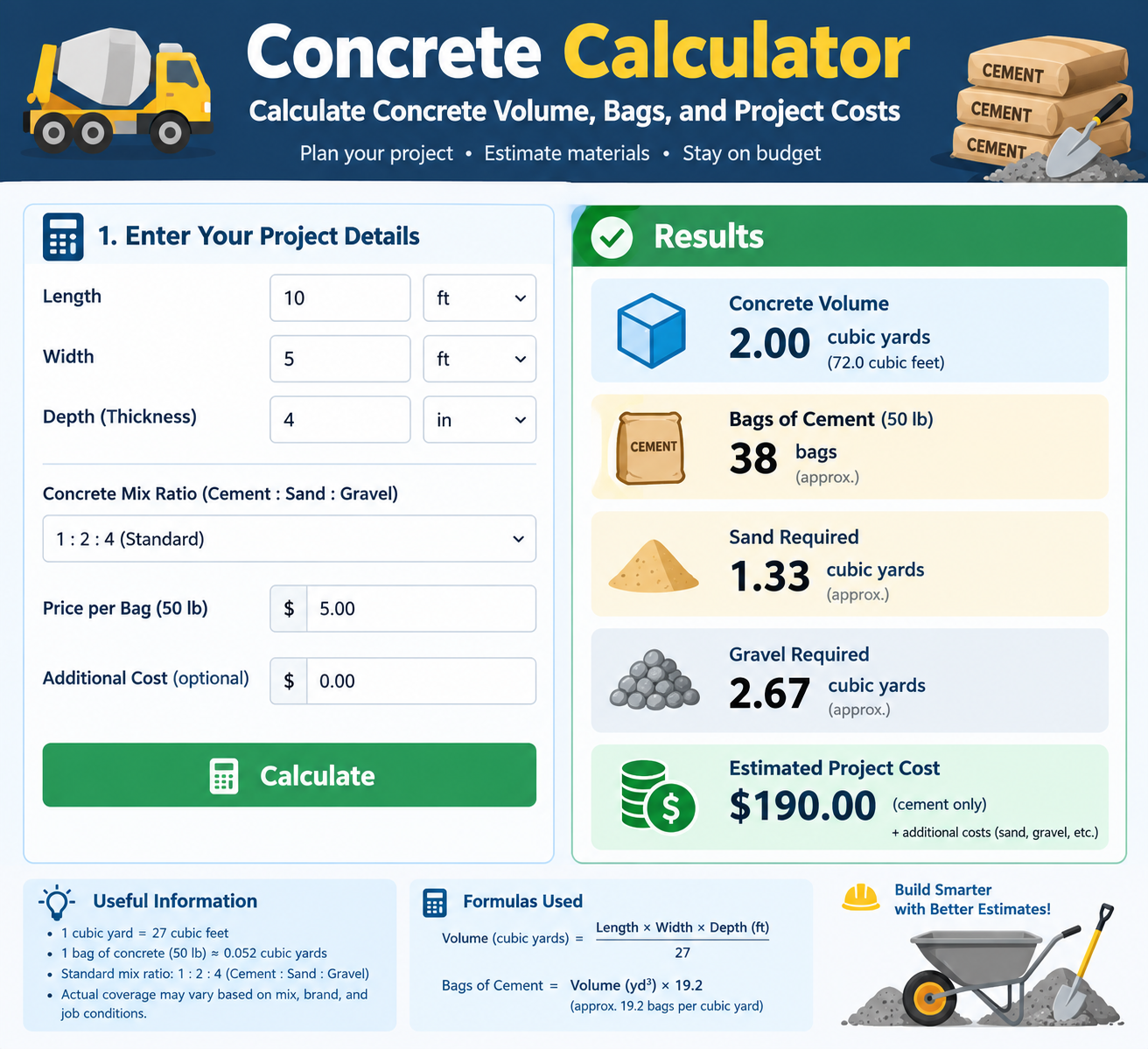
Planning a concrete project can feel confusing at first. You need to know how much material your project requires before buying supplies. Too little concrete can delay your work. Too much concrete can waste money and materials. A concrete calculator helps you estimate the amount you need before starting construction.
You can use this helpful tool for driveways, patios, sidewalks, floors, and concrete footings. Simply enter your project’s length, width, and depth. The calculator estimates the concrete volume in cubic feet, cubic yards, or cubic meters. Some calculators also estimate bag quantities and material costs.
In this guide, you will learn how concrete calculations work. We will explain common formulas, practical examples, and useful tips for better estimates. You will also discover how to avoid common measuring mistakes. Whether you are planning a small home project or a larger construction job, these simple steps can help you prepare with confidence.
What Is a Concrete Calculator?
A concrete calculator is a tool that estimates the concrete required for a construction project. It uses measurements to calculate the space that concrete must fill. You can use it before ordering ready-mix concrete or purchasing bagged concrete products.
Most calculators ask for three basic measurements: length, width, and thickness. Some also support round columns, circular slabs, steps, and irregular shapes. After entering the required information, you receive an estimated volume. Advanced tools may also calculate material costs and the number of concrete bags needed.
For example, imagine building a small backyard patio. You measure its length as 10 feet and its width as 10 feet. The planned thickness is 4 inches. A calculator uses these measurements to estimate the required volume. You can then plan your concrete order more accurately. However, the result remains an estimate. Accurate measurements and suitable allowances are still important for a successful project.
How Does a Concrete Calculator Work?
A concrete calculator uses basic geometry to find the volume of a space. Volume tells you how much room the concrete will occupy. For a rectangular slab, you multiply the length by the width and thickness. All measurements must use the same unit before calculating.
For example, a slab measuring 12 feet long and 10 feet wide has a surface area of 120 square feet. If its thickness is 4 inches, convert that measurement into feet first. Four inches equals one-third of a foot. Multiply 120 by one-third to get 40 cubic feet.
You can convert this result into cubic yards by dividing 40 by 27. The answer is about 1.48 cubic yards. This number represents the slab’s estimated concrete volume. A calculator performs these steps quickly and reduces manual calculation errors. Always check your measurements before using the final result to place an order.
Concrete Volume Formula Explained
Understanding the concrete volume formula helps you check your estimate. For a rectangular slab, use this simple formula:
Volume = Length × Width × Thickness
The result depends on the measurement units you choose. If all measurements use feet, your answer will be in cubic feet. If all measurements use meters, your answer will be in cubic meters. Never mix inches, feet, and meters without converting them first.
For instance, a 15-foot driveway with a width of 10 feet and thickness of 6 inches needs a different calculation from a 4-inch patio. Convert 6 inches into 0.5 feet. Then multiply 15 × 10 × 0.5. The estimated volume is 75 cubic feet.
To convert cubic feet into cubic yards, divide the answer by 27. This gives approximately 2.78 cubic yards. Actual ordering quantities may need a small allowance for uneven ground, spillage, and other site conditions. Your project design should determine the correct concrete thickness.
How to Calculate Concrete for a Slab
Concrete slabs are common in patios, garage floors, sheds, and outdoor seating areas. Their concrete requirements depend on the slab’s dimensions and thickness. Begin by measuring the length and width of the prepared area. Next, determine the thickness specified for your project.
Suppose your patio measures 12 feet long and 12 feet wide. Its planned thickness is 4 inches, or one-third of a foot. Multiply the measurements to calculate the volume. The result is 48 cubic feet, equal to approximately 1.78 cubic yards.
A concrete calculator makes this process easier by handling unit conversions automatically. Before pouring, check the ground level and formwork dimensions. A sloped or uneven base can change the amount of concrete required. Also, consider whether your project needs reinforcement or a special concrete mix. These choices depend on the intended use, soil conditions, and local construction practices.
How to Estimate Concrete for Driveways and Sidewalks
Driveways and sidewalks often require more planning than small slabs. Their lengths, widths, and thicknesses can vary across the project. Start by measuring each section separately. If the driveway has a rectangular shape, calculate its volume using the standard slab formula.
For example, a driveway measuring 20 feet long and 12 feet wide has an area of 240 square feet. At 6 inches thick, it requires approximately 120 cubic feet of concrete. This equals about 4.44 cubic yards before adding any allowance.
Sidewalks usually have smaller dimensions, but their length can make the total volume significant. Measure curves and wider sections carefully. For irregular areas, divide the surface into simple shapes and calculate each part separately. Add the individual volumes together for your total estimate. Remember that driveway thickness should suit the expected vehicle loads and ground conditions. Follow an appropriate construction plan instead of choosing thickness based only on cost.
How Many Concrete Bags Do You Need?
Bagged concrete can be useful for fence posts, small repairs, steps, and other limited projects. Each bag produces a different amount of mixed concrete, depending on its size and product instructions. Therefore, check the stated yield on the bag before calculating the required quantity.
Suppose your project needs 8 cubic feet of concrete. Your chosen product produces 0.6 cubic feet per bag. Divide 8 by 0.6 to get approximately 13.34 bags. Since you cannot purchase a fraction of a bag, you would need at least 14 bags. A small additional allowance may be sensible.
A concrete calculator with a bag estimator can simplify this process. However, bag weight alone does not tell you the exact yield. Different products can produce different amounts of finished concrete. Check the manufacturer’s instructions for water requirements, mixing steps, and curing guidance. For larger projects, compare the cost and convenience of bagged products with ready-mix delivery.
Concrete Calculator for Footings and Foundations
Footings support structures by transferring their loads into the ground. Their dimensions depend on the building design, soil conditions, and expected loads. Because these factors affect safety, do not choose footing sizes using a volume estimate alone. Use an appropriate building plan or qualified professional’s advice.
For a simple rectangular footing, multiply its length, width, and depth. Suppose one footing measures 3 feet long, 2 feet wide, and 1 foot deep. Its volume is 6 cubic feet. If your project has four identical footings, multiply 6 by four. The combined volume is 24 cubic feet, or approximately 0.89 cubic yards.
A concrete calculator helps you total the material required for multiple footings. If the footings have different sizes, calculate each one separately. Add their volumes together before planning your order. Also, inspect the excavation before pouring. Loose soil, water, or unexpected changes in ground conditions may require attention before construction continues.
Concrete Calculator for Round Columns and Circular Slabs
Round columns and circular slabs need a different formula from rectangular projects. Their volume depends on the radius and height. The radius is the distance from the center of a circle to its outside edge. If you know the diameter, divide it by two to find the radius.
Use this formula for a cylinder:
Volume = 3.1416 × Radius² × Height
For example, a round column has a radius of 0.5 feet and a height of 8 feet. Multiply 3.1416 by 0.5 squared and then by 8. The estimated volume is approximately 6.28 cubic feet.
A calculator designed for round shapes can perform this calculation automatically. Make sure you enter the radius or diameter in the correct field. Confusing these measurements can produce a large error. For several columns, calculate one column’s volume and multiply it by the total number of identical columns. Check the formwork dimensions before ordering concrete.
Convert Concrete Measurements Into Cubic Yards and Cubic Meters
Concrete suppliers commonly quote ready-mix quantities in cubic yards or cubic meters. Understanding these units helps you compare your calculated volume with supplier estimates. Cubic feet are useful for smaller calculations, while cubic yards are common in many United States construction projects.
Use these conversions:
- 1 cubic yard = 27 cubic feet.
- 1 cubic meter = approximately 35.315 cubic feet.
- 1 cubic meter = approximately 1.308 cubic yards.
- 1 foot = 12 inches.
- 1 meter = 100 centimeters.
Suppose your project requires 54 cubic feet of concrete. Divide 54 by 27 to get 2 cubic yards. For a metric project, enter all dimensions in meters to calculate cubic meters directly. A concrete calculator can reduce conversion mistakes and make supplier discussions easier. Always confirm the measurement unit used in your supplier’s quotation. Never assume cubic feet, cubic yards, and cubic meters are interchangeable.
How Much Extra Concrete Should You Order?
Your calculated volume represents the space measured on paper. Real construction sites may have uneven ground, small measurement errors, or minor losses during placement. For this reason, contractors often consider an additional allowance when planning a concrete order.
A common planning example is adding 5% to the calculated volume. If your estimate is 4 cubic yards, a 5% allowance adds 0.2 cubic yards. Your preliminary order estimate becomes 4.2 cubic yards. This percentage is only an example, not a rule for every project. Complicated shapes or uneven excavation may need a different allowance.
Before ordering, inspect the prepared area and confirm the formwork dimensions. Ask your supplier about delivery quantities, minimum order sizes, and any rounding requirements. For a large pour, running short can cause delays and visible joints. Ordering too much can also increase costs and create disposal problems. Balance these risks by checking your measurements carefully and discussing the final quantity with your contractor or concrete supplier.
Estimate Concrete Material Costs
Concrete costs depend on several factors. These include the required volume, mix type, local prices, delivery distance, and project size. Additional expenses may include reinforcement, formwork, tools, labor, and surface finishing. A material estimate should consider these items instead of focusing only on concrete volume.
For example, suppose you need 3 cubic yards of concrete. Your supplier charges $150 per cubic yard. The estimated concrete material cost is $450 before delivery, taxes, and other charges. If delivery costs $75, the combined subtotal becomes $525. These prices are examples only and do not represent current market rates.
A concrete calculator with a cost feature can help you compare different project estimates. Enter your supplier’s actual price to improve the result. If you are buying bagged concrete, multiply the required bag count by the price per bag. Remember to include waste allowances and any extra materials. Request a written quotation when possible so you can compare the full project cost more fairly.
Common Concrete Calculation Mistakes to Avoid
Small measurement mistakes can create expensive problems. One common error is entering thickness in inches while using feet for length and width. Another is confusing the radius with the diameter when calculating round columns. These mistakes can make the estimated volume incorrect.
Always convert measurements into consistent units before calculating. Measure each side carefully and check whether the area includes steps, curves, or separate sections. If the ground slopes, do not assume the thickness remains constant. You may need several measurements or a more detailed calculation.
Also, avoid treating the calculator’s answer as an exact order quantity. The final requirement depends on the prepared site, product yield, and pouring conditions. Check the result against your drawings and supplier recommendations. For structural projects, follow the specified mix and design. Careful planning helps control waste, but it should never replace sound construction practices or professional guidance when safety matters.
Tips for Getting the Most Accurate Concrete Estimate
Good estimates begin with accurate measurements. Use a reliable tape measure and record each dimension clearly. Check the length, width, and thickness at more than one point when the area is uneven. For large projects, divide the area into smaller sections that are easier to measure.
Enter the correct units into your concrete calculator. If the tool supports different shapes, select the option that matches your project. Calculate separate sections individually when their dimensions differ. Then add the results together to find the total volume.
Review the result before purchasing materials. Compare the calculated quantity with the construction plan and ask your supplier about practical ordering requirements. Confirm the concrete mix is suitable for the project’s purpose and environment. Finally, plan for access, equipment, and enough workers during the pour. Good preparation saves time and helps prevent costly interruptions. A careful estimate is one important part of a successful concrete project.
Benefits of Using an Online Concrete Calculator
An online concrete calculator saves time by handling common calculations automatically. Instead of working through every formula by hand, you can enter measurements and receive an estimated volume. This is especially helpful when comparing different slab sizes or planning several footings.
The tool also makes it easier to compare units. You can convert cubic feet into cubic yards or cubic meters without repeating the math manually. Some tools estimate bag quantities and material costs, which can help with budgeting. These features are useful for homeowners, builders, and people planning simple repairs.
However, the calculator is only as accurate as the information you provide. Incorrect dimensions produce incorrect results, even when the formula is correct. Choose a tool that supports your project’s shape and measurement units. Then review the output before placing an order. For complicated or structural work, use the calculator as a planning aid alongside suitable professional advice.
Conclusion
Estimating concrete does not need to be difficult. With the correct measurements and a clear formula, you can work out the volume for slabs, driveways, footings, and round columns. A concrete calculator makes these steps faster and helps you plan material purchases more confidently.
Start by measuring the project’s length, width, and thickness. Convert the measurements into consistent units and select the correct shape. Review the estimated volume, consider a suitable waste allowance, and check local supplier prices. Remember that concrete thickness, mix design, and footing dimensions must match your project’s requirements.
Careful planning can reduce waste, control costs, and prevent avoidable delays. Before starting your next project, calculate your concrete needs and confirm the final order with your supplier. If you have a project in mind, share its length, width, and thickness. You can then work out the estimated volume using the simple methods explained in this guide.
Frequently Asked Questions (FAQs)
1. What is a concrete calculator used for?
A concrete calculator estimates how much concrete a project requires. It uses measurements to calculate volume for slabs, driveways, footings, columns, and other shapes. Some tools also estimate concrete bags and material costs. You should still verify the result before ordering supplies.
2. How do I calculate concrete volume manually?
Multiply the length by the width and thickness of a rectangular area. Make sure all measurements use the same unit. If your dimensions are in feet, the result is cubic feet. Divide cubic feet by 27 to convert the volume into cubic yards.
3. How much concrete do I need for a 10-by-10-foot slab?
For a 10-by-10-foot slab with a thickness of 4 inches, you need approximately 33.33 cubic feet of concrete. This equals about 1.23 cubic yards before adding a waste allowance. The actual amount depends on the prepared area’s dimensions and thickness.
4. How many bags of concrete make one cubic yard?
The number depends on the yield printed on each bag. A bag producing 0.6 cubic feet would require 45 bags to make 27 cubic feet, which equals one cubic yard. Always check the product label because yields vary between products and bag sizes.
5. Should I order extra concrete?
An additional allowance can help cover small measurement errors, uneven surfaces, and placement losses. For example, a 5% allowance on 2 cubic yards adds 0.1 cubic yards. The correct allowance depends on site conditions and project complexity. Ask your supplier or contractor for guidance.
6. Is an online concrete calculator accurate?
An online calculator can provide a reliable mathematical estimate when you enter correct measurements and select the right shape. However, it cannot automatically account for every site condition. Check the dimensions, consider an appropriate allowance, and confirm the final quantity before ordering concrete.
